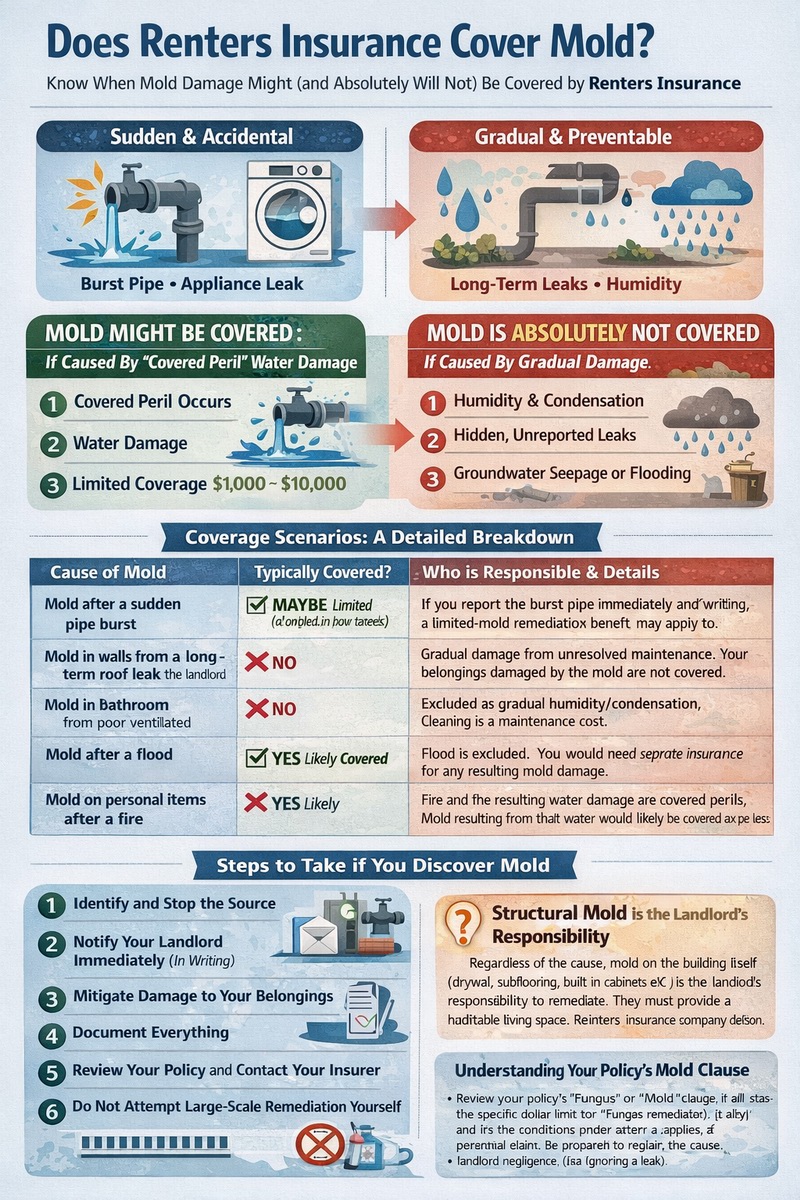
Renters insurance rarely covers mold damage. Standard policies typically exclude or severely limit coverage for mold, fungus, and dry rot. However, there is a narrow exception: if the mold is the direct result of a “covered peril” that is sudden and accidental, such as water damage from a burst pipe or a leaking appliance, your policy may cover a limited amount for mold remediation of your affected belongings. Mold that results from long-term humidity, condensation, unresolved leaks, or poor maintenance is always excluded. Crucially, renters insurance does not cover the cost to remediate mold on the building itself—that’s the landlord’s responsibility. For foundational knowledge, see our guide on what renters insurance is.
The “Sudden and Accidental” vs. “Gradual” Distinction
When asking “does renters insurance cover mold?” the entire answer hinges on the cause. Insurance is designed for sudden, unforeseen events—not slow, preventable problems. Mold is a classic “gradual damage” issue that policies are built to exclude. The key question is: Was the water source that caused the mold a covered, sudden event?
When Mold MIGHT Be Covered (The Narrow Exception)
If mold results from a covered water loss event, some policies may provide a small, sub-limited amount for remediation. The sequence must be:
- A covered peril occurs (e.g., a sudden burst pipe, an overflowing washing machine, fire sprinkler discharge).
- That event causes water damage to your personal property.
- Despite reasonable efforts to dry the area, mold develops as a direct consequence.In this case, the insurer might cover the cost to clean mold off your salvageable belongings (e.g., furniture, clothing) or declare them a total loss. Coverage is often capped between $1,000 and $10,000, and you must have taken steps to mitigate the water damage promptly. This is a specific part of your renters insurance coverage.
When Mold is ABSOLUTELY NOT Covered
Mold is explicitly excluded when it results from:
- Long-term humidity or condensation (e.g., from a constantly steamy bathroom without ventilation).
- Slow, hidden leaks you failed to report or address (e.g., a dripping pipe under a sink for months).
- Flooding or groundwater seepage (standard policies exclude flood).
- General lack of maintenance or neglect (e.g., not using a dehumidifier in a damp basement).In these scenarios, the mold is considered a maintenance issue, and you have no coverage for your belongings or any remediation costs.
Coverage Scenarios: A Detailed Breakdown
The following table clarifies the complex answer to “does renters insurance cover mold?” by examining common real-world situations.
| Cause of Mold | Typically Covered? | Who is Responsible & Details |
|---|---|---|
| Mold on your clothes/furniture after a sudden pipe burst. | MAYBE (Limited) | If you report the burst pipe immediately and mold still forms, a limited mold remediation benefit may apply to your belongings. The landlord fixes the pipe and building structure. |
| Mold in walls from a long-term roof leak the landlord ignored. | NO | Gradual damage from unresolved maintenance. Your belongings damaged by the mold are not covered. The landlord is responsible for fixing the roof and remediating mold in the structure. |
| Mold in bathroom from poor ventilation over years. | NO | Excluded as gradual humidity/condensation. Cleaning is a maintenance cost for the tenant or landlord, depending on the lease. |
| Mold after a flood from heavy rain. | NO | Flood is excluded. You would need separate flood insurance for any resulting mold damage to belongings. |
| Mold on personal items after a fire (from water used to extinguish it). | YES (Likely) | Fire and the resulting water damage are covered perils. Mold resulting from that water would likely be covered as part of the loss. |
The Landlord’s Responsibility for Structural Mold
Regardless of the cause, mold on the building itself (drywall, subflooring, built-in cabinets) is the landlord’s responsibility to remediate. They must provide a habitable living space. Your renters insurance only covers your personal property. If landlord negligence (like ignoring a leak) causes mold that ruins your belongings, you may have a liability claim against them, not an insurance claim.
Steps to Take if You Discover Mold
- Identify and Stop the Source: If it’s an active leak (like a burst pipe), stop the water if safe to do so.
- Notify Your Landlord Immediately (In Writing): They are responsible for investigating and fixing the source in the building. Document your notification.
- Mitigate Damage to Your Belongings: Move unaffected items away from the area. Begin drying out wet items promptly. This “duty to mitigate” is in your policy.
- Document Everything: Take photos and videos of the mold, the suspected water source, and any damaged belongings.
- Review Your Policy and Contact Your Insurer: If you believe the mold stems from a sudden, covered event, contact your renters insurance company to discuss a potential claim. Be prepared to explain the cause.
- Do Not Attempt Large-Scale Remediation Yourself: For significant mold, professional assessment and remediation are needed. Your landlord should arrange this for the structure.
Preventing Mold: Your Best Defense
Since coverage is so limited, prevention is key:
- Use exhaust fans in bathrooms and kitchens.
- Promptly report any signs of leaks or moisture to your landlord.
- Use a dehumidifier in damp areas like basements.
- Dry wet items (towels, rugs) quickly.
- Ensure your belongings are not stored directly on concrete floors in basements.
Understanding Your Policy’s Mold Clause
Review your policy’s “Fungus” or “Mold” clause. It will state the specific dollar limit for “fungus remediation” (if any) and list the conditions under which it applies. Many policies have a $5,000 or $10,000 cap for all fungus-related losses, which includes testing, removal, and repair of covered property. This limit is often aggregate, not per incident. Understanding this is part of managing your overall renters insurance cost and protection. For a full review, explore all renters insurance options.
Conclusion: Assume You’re Not Covered, Then Prove Otherwise
In summary, does renters insurance cover mold? The default assumption should be no. Coverage is an extremely limited exception that applies only when mold is an unavoidable consequence of a sudden, covered water event and you acted quickly to mitigate it. For the vast majority of mold cases—those stemming from humidity, neglect, or gradual leaks—you are financially responsible for your damaged belongings, and your landlord is responsible for the building. Protect yourself through prevention, prompt reporting, and understanding that your security deposit is often the real “insurance” against minor mold-related cleaning charges when you move out.
Frequently Asked Questions (FAQ)
Does renters insurance cover mold inspection or testing?
Generally, no. The cost of testing to confirm the presence or type of mold is typically not covered unless it is part of a legitimate claim for a covered loss. If mold is excluded, the testing cost is also excluded.
What if I have a mold allergy and need to temporarily relocate?
If the mold is due to a covered peril and your unit is uninhabitable, your Additional Living Expenses (ALE) coverage would pay for a hotel. If the mold is from an excluded cause (like long-term humidity), ALE does not apply, even if a doctor recommends you leave.
Does the landlord’s insurance cover mold damage to my belongings?
No. The landlord’s property insurance covers the structure, not your personal property. If their negligence caused the mold, you would need to seek reimbursement from them directly (or through a liability claim against them), not through their insurance.
Can I buy additional mold coverage?
Some insurers may offer a mold endorsement that increases the sub-limit for fungus remediation or provides broader terms, but these are not commonly offered for renters policies. It’s more common in homeowners insurance in high-humidity states. Ask your agent.
What if the mold is hidden behind a wall and I didn’t know?
The “hidden” nature doesn’t change the cause. If the hidden leak was sudden (a pipe burst last week), it might be covered. If it was a slow leak from a loose fitting over two years, it’s excluded as gradual damage. The key is the nature of the water source, not when you discovered it.
Will a small mold claim increase my premium or get me non-renewed?
Very possibly. Mold is a red flag for insurers due to high remediation costs and health concerns. Filing even a limited mold claim can lead to a significant premium increase or the insurer choosing not to renew your policy.
Where can I find official health information on mold?
For authoritative health and safety information on mold, visit the Centers for Disease Control and Prevention (CDC) Mold page. It provides crucial guidance on health effects, cleanup, and prevention.