

The answer to “does renters insurance cover liability” is a definitive yes, and this coverage is arguably the most critical component of any renters policy. Personal liability protection shields you from financial ruin if you are found legally responsible (liable) for causing bodily injury to someone else or damaging their property. This coverage pays for the injured party’s medical bills, your legal defense fees, court costs, and any settlements or judgments up to your policy limit. It applies both inside your rental unit and anywhere in the world. Common scenarios include a guest slipping and falling in your apartment, your dog biting a neighbor, or you accidentally causing damage to another person’s property. With standard liability limits starting at $100,000 but often recommended at $300,000 to $500,000, this coverage is an indispensable safety net that protects your savings, future income, and assets from devastating lawsuits.
What Is Personal Liability Coverage in Renters Insurance?
Personal liability coverage, often labeled as Coverage E in a renters insurance policy, is a contractual agreement where your insurance company agrees to handle the financial consequences if you are legally obligated to pay for harm you cause to others. It operates on the principle of negligence—if your careless action (or inaction) results in injury or damage, your liability coverage responds. This protection is not just for catastrophic events; it covers everyday accidents that can quickly escalate into expensive legal battles. Unlike property coverage, which has a deductible, liability coverage typically pays out from the first dollar after a covered incident, up to your chosen limit, with no deductible applied.
The Legal and Financial Shield
Imagine a guest trips over a loose rug in your living room, breaks a wrist, and sues you for $50,000 in medical bills and pain and suffering. Without liability insurance, you would have to hire a lawyer and pay any settlement out of your own pocket. With renters insurance liability coverage, your insurer provides a legal defense and covers the costs, up to your limit. This protection extends beyond your home. If you accidentally cause a sporting injury to someone at the park or damage an expensive item in a friend’s home, your liability coverage can follow you and provide protection.
Standard Coverage Limits and Structure
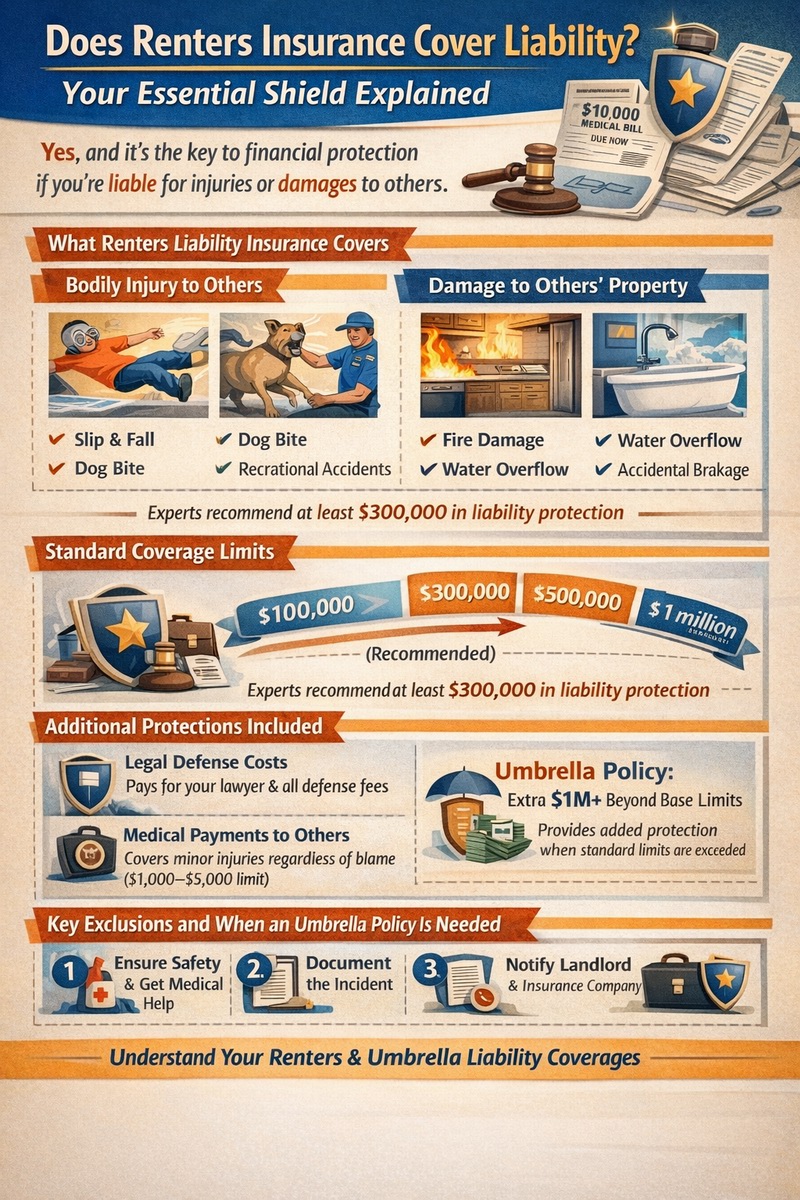
When you purchase a policy, you select a personal liability limit. This is the maximum amount your insurance company will pay for all claims and defense costs arising from a single incident. Common standard limits are $100,000, but policies often allow you to increase to $300,000, $500,000, or even $1 million. Given the high cost of medical care and lawsuits, experts strongly recommend a minimum of $300,000 in liability coverage. The cost to increase from $100,000 to $300,000 is usually minimal—often just $20-$30 more per year—but provides triple the protection.
What Does Renters Insurance Liability Specifically Cover?
Renters insurance liability coverage is broad, but it’s important to understand the specific scenarios it is designed to address. The coverage generally includes payment for damages the insured is legally obligated to pay due to “bodily injury” or “property damage” caused by an “occurrence” (an accident).
Bodily Injury to Others
This covers physical harm to someone else for which you are held liable. Classic examples include:
- Slip and Fall: A delivery person or guest slips on a wet kitchen floor you just mopped and injures their back.
- Dog Bites: Your pet bites a neighbor or visitor. (Note: Some breeds may be excluded; always disclose your pet.)
- Recreational Accidents: You accidentally hit someone with a golf ball or baseball.
- Negligent Supervision: A child you are babysitting gets injured while in your care.
The coverage pays for the injured person’s medical expenses, lost wages, and “pain and suffering” damages awarded by a court.
Damage to Others’ Property
This covers physical damage you cause to property you don’t own. Scenarios include:
- Fire Damage: A kitchen fire you accidentally start spreads to and damages other units in your apartment building.
- Water Overflow: You leave a bathtub running, causing water damage to the unit below you.
- Accidental Breakage: You knock over and shatter an expensive antique vase while visiting a friend’s home.
The coverage pays to repair or replace the damaged property. For a comprehensive look at how this integrates with other protections, see our guide on renters insurance coverage.
Additional Coverages Included
Liability coverage also typically includes two other essential benefits at no extra cost:
- Legal Defense Costs: If you are sued, your insurer will hire and pay for an attorney to defend you. These costs are paid in addition to your liability limit in most policies, which is a huge benefit.
- Medical Payments to Others (MedPay): This is a smaller, no-fault coverage (e.g., $1,000 – $5,000) that pays for minor medical bills if someone is hurt in your home, regardless of who was at fault. It’s meant to avoid lawsuits for small incidents.
| Scenario | Covered by Liability? | Key Notes & Limitations |
|---|---|---|
| A guest breaks an ankle after tripping on your child’s toy. | YES | Covers medical bills, lost wages, and legal defense if they sue. MedPay might cover initial small bills. |
| Your dog bites a mail carrier. | Usually YES* | *Subject to breed exclusions and the dog’s history. A major reason people need high liability limits. |
| You accidentally cause a kitchen fire that damages the building. | YES | Covers damage to the landlord’s building and other tenants’ property for which you are liable. |
| You are sued for libel or slander (defamation). | Typically NO | Personal injury (non-physical) like defamation is usually excluded from basic liability coverage. |
| You cause a car accident. | NO | Liability from auto accidents is covered by your auto insurance policy, not renters insurance. |
| You intentionally cause injury or damage. | NO | Insurance never covers intentional, criminal, or fraudulent acts. |
Key Exclusions and Limitations to Know
While broad, liability coverage is not all-encompassing. Knowing what is not covered is as important as knowing what is.
Common Exclusions in Liability Coverage
- Business Activities: Liability arising from running a business from your home (e.g., a client is injured during a consultation) is excluded. You need a business insurance policy.
- Professional Services: Malpractice or errors from providing professional advice (even for free) are not covered.
- Auto-Related Liability: Injuries or damage from the use of any motor vehicle are excluded and belong under an auto policy.
- Intentional Acts: Any harm you deliberately cause is excluded.
- Contractual Liability: Liability you assume under a contract (e.g., agreeing to be fully responsible for damages in a lease addendum) may have limited coverage.
The Importance of Adequate Limits and Umbrella Policies
A severe injury like a traumatic brain injury or spinal damage can result in a lawsuit seeking millions. If a judgment exceeds your renters liability limit, your personal assets (savings, investments, future wages) can be seized. To guard against this, consider a personal umbrella liability policy. This is a separate, affordable policy that provides an extra $1 million or more in coverage on top of your renters and auto liability limits. It only activates after your underlying limits are exhausted. For renters with assets to protect or high-risk exposures (like a dog or a swimming pool), an umbrella policy is a wise investment. Understanding your total renters insurance cost should include evaluating the value of an umbrella policy.
The Claims Process for a Liability Incident
If an incident occurs that could lead to a liability claim, taking the correct steps is crucial to ensure your coverage works as intended.
Immediate Steps After an Incident
1. Ensure Safety and Seek Medical Help: Address any immediate medical needs for the injured person.
2. Document the Incident: Take photos of the scene, get contact information for any witnesses, and write down your own account of what happened while it’s fresh.
3. Do Not Admit Fault or Promise Payment: Be compassionate but cautious. Say things like “I’m sorry this happened” rather than “This was all my fault.” Admitting liability can complicate the claims process.
4. Notify Your Landlord: If the incident involves damage to the rental property, inform your landlord promptly.
How to File a Liability Claim
Contact your insurance company or agent as soon as possible to report the incident, even if no lawsuit has been filed yet. Provide all the documentation you gathered. The insurer will assign a claims adjuster who will investigate, communicate with the injured party or their attorney, and manage the defense if a lawsuit is filed. Your role is to cooperate fully with the adjuster and the defense attorney provided. The insurer has a duty to defend you, and they will work to settle the claim within your policy limits if possible.
Why Landlords Require Renters Insurance Liability Coverage
Most landlords and property management companies now require tenants to carry renters insurance, with a minimum liability limit (often $100,000 or $300,000). This requirement protects the landlord’s interests in two key ways.
Shifting Financial Responsibility
If you cause a fire that damages the building, the landlord’s insurance will pay for the structural repairs. However, their insurer will then likely pursue you (through a process called “subrogation”) to recover the money they paid. If you have renters insurance liability coverage, your policy will handle this subrogation claim, protecting you from a massive bill from the landlord’s insurance company.
Reducing Landlord Liability
If a guest is injured in a common area due to your negligence (e.g., you left a spill), the injured party might sue both you and the landlord. Your liability coverage ensures there is a dedicated pool of money to handle the claim, reducing the likelihood that the landlord’s insurance will need to get involved. This makes you a more responsible and lower-risk tenant. For more on this relationship, visit our main resource at Tejribati.
Conclusion
So, does renters insurance cover liability? Absolutely, and it is the cornerstone of the financial protection the policy provides. It defends you against the potentially catastrophic costs of lawsuits for injury and property damage you accidentally cause. Given the modest cost of increasing your limits and the severe financial consequences of being underinsured, every renter should carry robust liability coverage of at least $300,000 and seriously consider an umbrella policy. Don’t make the mistake of thinking your landlord’s insurance protects you—it doesn’t. Your renters insurance liability coverage is your personal legal shield, safeguarding your finances and your future. Review your policy today to ensure you have the strong protection you need.
Frequently Asked Questions (FAQ)
Does renters insurance liability cover my roommate?
It depends on how the policy is written. If your roommate is listed as a “named insured” on the policy, they are covered. If they are not listed, they likely have no liability coverage under your policy and should purchase their own. Most insurers allow roommates to be jointly insured on one policy, but it’s important to disclose all occupants to the insurance company.
What is the difference between liability and medical payments coverage?
Liability coverage requires you to be legally at fault (negligent) and covers larger claims, including lawsuits. Medical Payments to Others (MedPay) is “no-fault” coverage for smaller medical bills (e.g., $1,000-$5,000) if someone is hurt in your home, regardless of who caused it. It’s meant to foster goodwill and avoid small claims turning into liability lawsuits.
Does liability coverage protect me if I’m sued for libel or slander?
Typically, no. Standard renters liability coverage is for “bodily injury” and “property damage” from an accident. Non-physical injuries like defamation (libel/slander), invasion of privacy, or wrongful eviction are usually excluded. Some policies may offer an endorsement to add “personal injury” coverage for these situations, but it’s not standard.
Will my liability cover me if I cause damage at my friend’s house?
Yes, in most cases. Your renters insurance liability coverage is typically worldwide. If you are visiting a friend and accidentally break their expensive television or cause a fire, your liability coverage can pay for the damage for which you are found legally responsible, up to your policy limit.
Is there a deductible for liability claims?
No, there is usually no deductible applied to the liability portion of a renters insurance claim. The insurance company pays for covered losses and legal defense from the first dollar, up to your policy limit. Deductibles typically only apply to claims for damage to your own personal property.
Can my liability coverage be cancelled if I file a claim?
Filing a liability claim will not result in immediate cancellation. However, it is considered in your claims history at renewal time. Depending on the severity and frequency of claims, an insurer may choose not to renew your policy when it expires. A single, small claim may have little impact, but a major payout can affect your renewal options and premium.
How much liability coverage do I really need?
Industry experts and financial advisors generally recommend a minimum of $300,000 to $500,000 in personal liability coverage. The incremental cost to increase from $100,000 to $300,000 is very small (often $20-$50 per year) but provides triple the protection. If you have significant assets, a high-income profession, or higher-risk exposures (like a dog or a swimming pool), consider $500,000 or more plus an umbrella policy.