
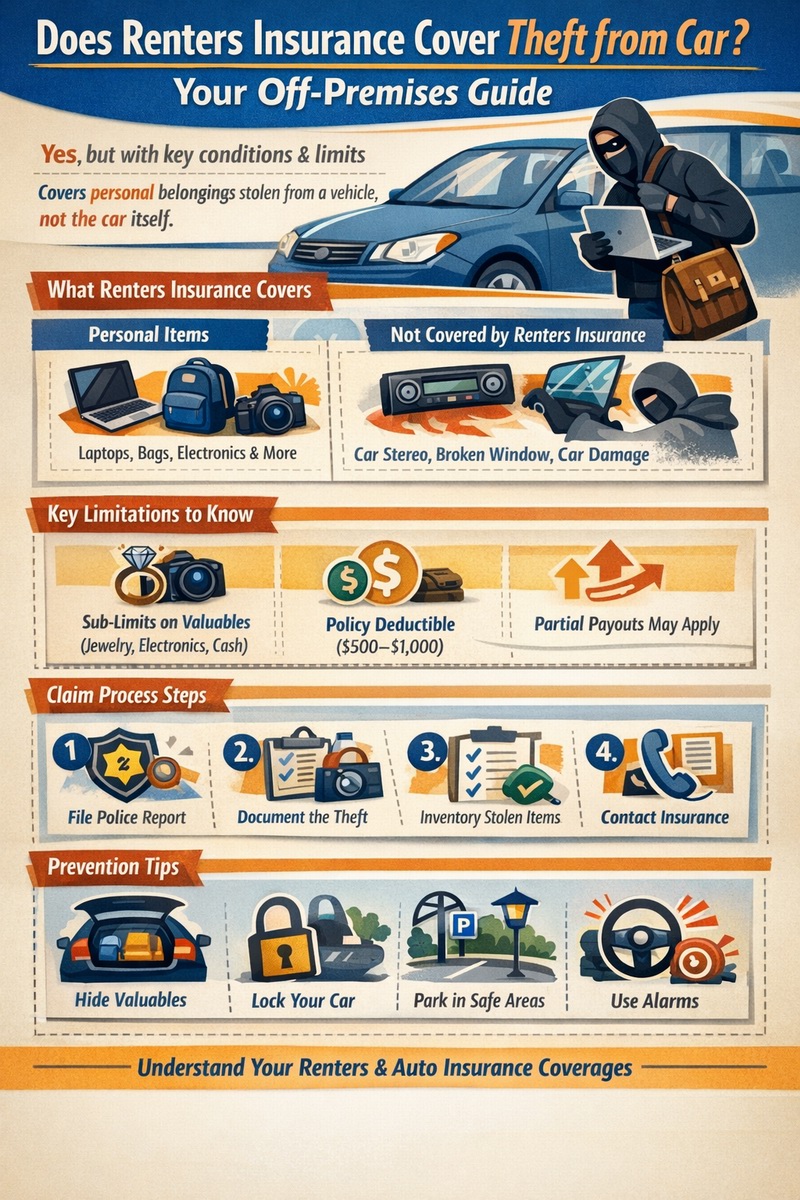
The answer to “does renters insurance cover theft from car” is generally yes, but with important conditions and limits. Your renters insurance personal property coverage typically extends to your belongings anywhere in the world, including when they are stolen from a locked or unlocked vehicle. This is known as “off-premises” coverage. However, this protection has key caveats: it only covers your personal items, not any part of the car itself (which is an auto insurance claim). There are also sub-limits for certain high-value categories like jewelry, electronics, or cash, meaning you may not be fully reimbursed for expensive items. Furthermore, you’ll need to pay your policy deductible, and the claim could affect your future premiums. Understanding the interplay between your renters and auto insurance policies is crucial to ensuring you have no gaps in coverage for your possessions, whether they’re at home, in your car, or anywhere else you take them.
How Renters Insurance Extends to Your Car
Standard renters insurance is designed to protect your personal property from named perils, with theft being one of the most common. A foundational feature of this coverage is that it usually isn’t confined to the four walls of your apartment. Most policies provide worldwide coverage for your belongings, meaning items are protected whether they are stolen from your home, your workplace, a hotel, or your parked car. This makes renters insurance a versatile and essential policy for mobile lifestyles. When asking “does renters insurance cover theft from car,” you’re tapping into this crucial off-premises benefit.
The “Off-Premises” Coverage Clause
Your policy’s personal property coverage (Coverage C) will state that it applies to covered property “anywhere in the world.” This clause is what allows you to file a claim for items stolen from your vehicle. The coverage limit is the same as your total personal property limit (e.g., $20,000), but the payout for any single event is subject to the terms and sub-limits within the policy. It’s vital to understand that this coverage is for your portable belongings, not for fixtures or items attached to the vehicle.
What’s Covered: Personal Property vs. Auto Parts
This is the critical distinction. Renters insurance covers your personal items inside the car. Auto insurance (specifically, comprehensive coverage) covers damage to or theft of the car itself.
- Renters Insurance Covers: Laptop, backpack, gym bag, clothing, purchases, sports equipment, and sunglasses stolen from the passenger cabin or trunk.
- Auto Insurance Covers: Broken window, damaged door lock, stolen stereo system (if permanently installed), stolen catalytic converter, or the entire vehicle.
In a smash-and-grab, you would likely file two claims: one with your auto insurer for the broken window, and one with your renters insurer for the stolen laptop. For a complete look at what renters insurance protects, see our guide on renters insurance coverage.
Key Limitations and Conditions to Understand
While the coverage exists, it is not a blank check. Several important limitations dictate how much you’ll actually recover after a theft from your vehicle.
Special Sub-Limits for High-Value Items
Most renters insurance policies have “special limits of liability” for certain categories of property, regardless of where they are stolen from. These sub-limits are often much lower than your total coverage. Common examples include:
- Jewelry, Watches, Furs: $1,000 – $2,500 total
- Silverware, Goldware: $2,500 – $5,000 total
- Firearms: $2,000 – $3,000 total
- Business Property: $2,500 – $5,000 total
- Electronics (for business): Often a separate limit
- Cash, Precious Metals: $200 – $500 total
If you have a $4,000 engagement ring stolen from your car, and your policy has a $1,500 sub-limit for jewelry, you will only receive up to $1,500, minus your deductible.
The Deductible and Its Impact
Every renters insurance claim is subject to your deductible, which is the amount you pay out-of-pocket before insurance kicks in. Deductibles commonly range from $500 to $1,000. If $800 worth of items is stolen and you have a $500 deductible, you would receive a $300 settlement from your insurer. For smaller losses, it may not make financial sense to file a claim, as the payout could be minimal and filing could increase your future premiums.
| Theft Scenario from Car | Covered by Renters Insurance? | Key Conditions & Notes |
|---|---|---|
| Backpack with laptop, textbooks, and clothes stolen from back seat. | YES | Subject to electronics sub-limits and your deductible. The laptop’s value may exceed a sub-limit. |
| Car stereo ripped out of the dashboard and stolen. | NO | This is part of the vehicle. File a claim under your auto insurance’s comprehensive coverage. |
| $5,000 in golf clubs stolen from the trunk. | YES, up to limits | Sports equipment is typically covered, but check for any special sub-limit. The full value may be covered if no sub-limit applies. |
| Cash and designer sunglasses from the center console. | PARTIALLY | Cash has a very low sub-limit (e.g., $200). Sunglasses may be covered as personal property but could fall under a jewelry/furs limit if very high-value. |
| Tools you use for your job stolen from a locked toolbox in the bed of a pickup truck. | MAYBE | Tools used for business often have a separate sub-limit (e.g., $2,500). Coverage may be limited or excluded if they are for commercial use. |
The Claims Process for Theft from a Vehicle
If you experience a theft from your car, taking the correct steps promptly can make the claims process smoother and increase the likelihood of a successful recovery.
Immediate Steps After Discovering the Theft
1. Contact the Police: File a police report immediately. This is a non-negotiable requirement for both renters and auto insurance claims. Get the report number and the officer’s name.
2. Secure the Vehicle: If a window is broken, take steps to prevent further damage (like covering it with plastic). Your auto insurer may require this to cover the window repair.
3. Document the Scene: Take photos of the vehicle’s damage (for auto insurance) and the area where your items were stolen from (e.g., empty space on the seat).
4. Create a Detailed Inventory: List every stolen item, including a description, brand, model, serial number (if you have it), approximate age, and estimated replacement cost. The more detail, the better.
Filing the Renters Insurance Claim
Contact your renters insurance company to start the claim. Provide them with:
- The police report number.
- Your completed inventory list.
- Any photos or documentation you have.
- Receipts, credit card statements, or photos of the items from before the theft, if available.
An adjuster will be assigned to review your claim. They will verify the items are covered, apply any relevant sub-limits, subtract your deductible, and issue a payment for the covered amount. Remember, if you have Actual Cash Value (ACV) coverage, you’ll get the depreciated value. If you have Replacement Cost Value (RCV) coverage, you may receive an initial ACV payment and then the balance after you replace the items and submit receipts.
Prevention and Risk Mitigation Strategies
Since filing a claim can increase your premiums and involve a deductible, prevention is the best strategy. Here’s how to minimize the risk of car break-ins and ensure you’re prepared if one occurs.
Smart Habits to Deter Thieves
- Never Leave Valuables in Sight: This is the #1 rule. Place items in the trunk before you arrive at your destination. A thief watching you move items to the trunk may still break in.
- Use a Car Safe or Lockable Console: For smaller items you must leave behind, a bolted-down safe can be a deterrent.
- Park in Well-Lit, High-Traffic Areas: Avoid isolated or dark parking spots.
- Always Lock Your Doors: Many thefts are crimes of opportunity from unlocked vehicles.
- Consider a Visible Alarm System or Steering Wheel Lock: These can discourage casual thieves.
Documentation and Proof of Ownership
Your ability to recover financially hinges on proof. Maintain a digital home inventory with photos, serial numbers, and receipts for high-value items you commonly transport, like laptops, cameras, or musical instruments. Store this inventory in the cloud (e.g., Google Drive, iCloud) so it’s accessible even if your devices are stolen. This documentation is invaluable for both police reports and insurance claims. Resources like the National Association of Insurance Commissioners (NAIC) offer free home inventory tools.
How This Coverage Fits into Your Overall Financial Plan
Understanding that renters insurance covers theft from your car allows you to better assess your overall insurance portfolio and avoid unnecessary or overlapping coverage.
Coordinating with Your Auto Insurance
Your auto insurance’s comprehensive coverage is for the car. Your renters insurance is for the stuff inside it. They are complementary, not duplicative. When budgeting for renters insurance cost, factor in the value it provides for your mobile electronics and other valuables. It’s often more cost-effective to rely on renters insurance for item theft than to add endorsements to an auto policy, which rarely cover personal effects comprehensively.
When to Consider Scheduled Personal Property
If you regularly transport items that exceed your policy’s sub-limits (e.g., professional camera equipment, expensive musical instruments), you should consider “scheduling” them on your renters policy. This involves getting a professional appraisal and paying an additional premium to specifically list the item with its value. This eliminates sub-limits and often provides broader coverage (e.g., “all-risk” instead of “named perils”). This is the best way to ensure full protection for specialized, high-value gear you carry in your car.
Conclusion
So, does renters insurance cover theft from car? Emphatically, yes—it is a core feature of the off-premises protection that makes renters insurance so valuable. It ensures your belongings are protected against theft no matter where you are. However, this coverage is governed by sub-limits for valuable categories, subject to your deductible, and does not replace the need for auto insurance to cover damage to the vehicle itself. To maximize your protection, practice prevention by never leaving items visible, maintain a detailed home inventory, and consider scheduling exceptionally valuable items. By understanding these details, you can leverage your renters insurance to its full potential, securing peace of mind for your possessions at home and on the go.
Frequently Asked Questions (FAQ)
Does renters insurance cover theft from an unlocked car?
Typically, yes. Unlike some auto insurance policies that may deny claims for theft from an unlocked vehicle, renters insurance generally does not have a clause requiring forced entry. Theft is a named peril, and it usually covers your belongings regardless of whether the car was locked. However, you must still have taken reasonable care of your property; leaving a car unlocked with a laptop in plain view might be seen as negligence in extreme cases, but it’s rarely a basis for denial.
Are items stolen from my work vehicle covered?
This depends on the use. If you use your personal vehicle for work and have personal items stolen, they are likely covered. However, if the vehicle is owned by your employer or is used primarily for commercial purposes, your renters insurance may have limitations or exclusions for business property. Tools used for your job often have a separate, lower sub-limit (e.g., $2,500). You may need a separate business insurance policy for full coverage of work-related equipment.
What if my car was also damaged during the theft?
You will likely need to file two separate claims: one with your auto insurance (under comprehensive coverage) for the damage to the car (broken window, damaged lock), and one with your renters insurance for the stolen personal items inside. Each claim will have its own deductible. Be sure to provide the police report number to both insurers.
Does it cover items stolen from a rental car?
Yes, the off-premises coverage in your renters insurance extends to rental cars as well. Your personal belongings are covered if stolen from a rented vehicle anywhere in the world. Some premium credit cards also offer rental car insurance for personal effects, so check your card’s benefits to avoid duplication, but your renters insurance is a reliable primary source of coverage.
Is there a time limit to report the theft to my insurance?
Most policies require you to report a loss “promptly” or “as soon as practicable.” It’s best to file the police report and notify your insurance company within 24-48 hours of discovering the theft. Delaying could complicate the investigation and potentially give the insurer grounds to dispute the claim.
How does the valuation (ACV vs. RCV) affect a theft claim?
This is crucial. If your policy has Actual Cash Value (ACV), you’ll be paid the stolen item’s depreciated value (what it was worth used). If you have Replacement Cost Value (RCV), you’ll be reimbursed the cost to buy a new equivalent item (often after you purchase it and submit a receipt). RCV provides significantly higher payouts and is a worthwhile endorsement to add to your policy.
Will filing a claim for car theft increase my renters insurance premium?
Filing any claim, including one for theft from a car, can affect your future premiums. Insurers may view you as a higher risk. The impact depends on your insurer’s policies, your claims history, and the claim amount. For a small claim close to your deductible amount, it may be more cost-effective to handle the loss out-of-pocket to avoid a potential rate increase.