

The General renters insurance, offered by The General Insurance Group (a subsidiary of American Family Insurance), is a policy designed to provide essential protection for tenants at a competitive price, often marketed toward those seeking straightforward, no-frills coverage. Like standard renters insurance, it covers personal property against named perils like fire, theft, and vandalism, provides personal liability protection, and includes Additional Living Expenses (ALE) if your rental becomes uninhabitable. The General is known for its accessible online quotes, simple application process, and focus on serving customers who may have difficulty obtaining coverage elsewhere. However, it’s crucial to scrutinize the specific policy details, limits, and exclusions, as coverage can be more basic compared to some national carriers. This guide will dissect The General’s offerings, pricing, pros and cons, and help you determine if it’s the right fit for your rental insurance needs.
Who Is The General and What Do They Offer?
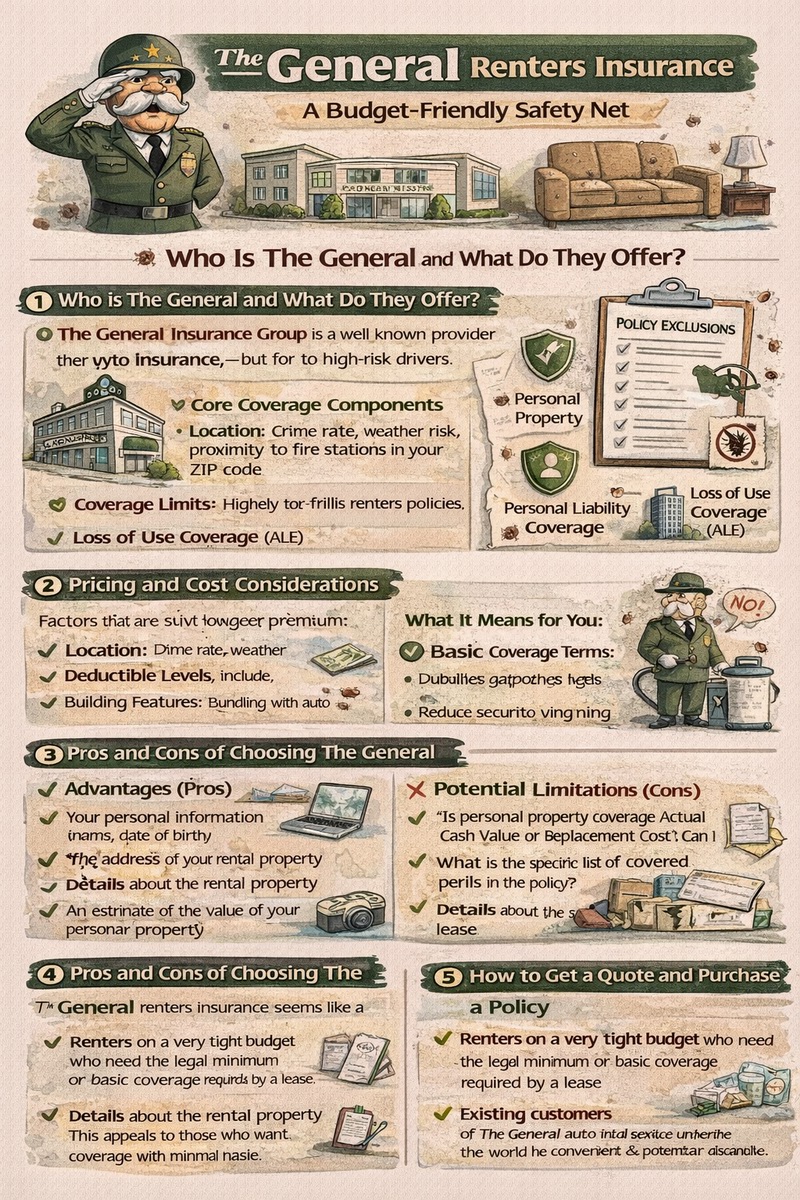
The General Insurance Group is a well-known provider specializing in auto insurance, particularly for high-risk drivers. They have expanded their portfolio to include renters insurance as a natural companion product. Their approach to renters insurance mirrors their auto business: offering policies that are easy to understand, quick to purchase (often entirely online or over the phone), and competitively priced. The goal is to provide a fundamental safety net for personal belongings and liability without complex endorsements or high premiums. It’s important to distinguish “the general renters insurance” as a category of protection from “The General” as a specific brand offering a product within that category.
Core Coverage Components of a Policy
A standard renters insurance policy from The General will include the three fundamental coverages:
- Personal Property Coverage (Coverage C): Protects your belongings (furniture, electronics, clothing) from covered perils like fire, lightning, windstorm, hail, theft, vandalism, and more. It’s essential to check their specific list of “named perils.”
- Personal Liability Coverage (Coverage E): Provides financial protection if you are found legally responsible for injuring someone or damaging their property. This can cover medical bills, legal defense costs, and settlements, typically starting at $100,000.
- Loss of Use / Additional Living Expenses (ALE) (Coverage D): Pays for temporary housing, meals, and other increased costs if a covered loss makes your rental unit uninhabitable.
These components align with the industry standard, providing a baseline of protection for most renters.
Policy Options and Customization
The General renters insurance may offer limited options for customization compared to more comprehensive carriers. You can typically select your personal property and liability limits and choose a deductible (e.g., $500, $1,000). Key questions to ask or look for include: Is the personal property coverage Actual Cash Value (ACV) or Replacement Cost Value (RCV)? ACV, which pays depreciated value, is more common in basic policies. Are there optional endorsements for valuable items like jewelry or identity theft? Availability may be limited. For a detailed explanation of these standard coverage elements, see our guide on renters insurance coverage.
Pricing and Cost Considerations
The General is frequently positioned as a low-cost provider. Their renters insurance cost is often attractive, but it’s vital to understand what influences the price and what might be sacrificed for that lower premium.
What Factors Influence Your Premium?
Like all insurers, The General considers several factors when calculating your premium:
- Location: Crime rate, weather risk, and proximity to fire stations in your ZIP code.
- Coverage Limits: Higher limits for personal property or liability increase your premium.
- Deductible: Choosing a higher deductible (the amount you pay out-of-pocket per claim) lowers your premium.
- Building Details: The age, construction type, and security features of your rental building.
- Claims History and Credit Score: In many states, your insurance score (based in part on credit) can affect your rate.
Their streamlined underwriting may result in quicker quotes but potentially less personalized pricing.
How The General’s Pricing Compares
The General often markets competitive rates, particularly for customers who may receive higher quotes from other companies due to past claims, credit history, or other risk factors. However, the lower premium frequently correlates with more basic coverage terms (like ACV instead of RCV) and potentially higher deductibles. It is absolutely crucial to compare not just the price but the value—the coverage details and limits you receive for that price.
| Consideration | Typical for The General Renters Insurance | What It Means for You |
|---|---|---|
| Premium Cost | Often on the lower end of the market | Can provide significant savings, but ensure the coverage is adequate. |
| Valuation Method | Likely Actual Cash Value (ACV) as standard | In a claim, you receive the depreciated value of items, not the cost to buy new. This can mean much lower payouts. |
| Customization & Endorsements | May be limited | You may not be able to add high-value item scheduling or water backup coverage as easily. |
| Discounts | Multi-policy (bundling with auto), safety features, claims-free | Bundling with The General auto insurance could offer the most significant savings. |
| Deductible Options | Standard range (e.g., $500-$1,000+) | A higher deductible lowers your premium but increases your out-of-pocket cost when you file a claim. |
Pros and Cons of Choosing The General
Evaluating The General renters insurance requires a balanced look at its advantages for certain customers and its potential limitations.
Advantages (Pros)
- Competitive Pricing: For budget-conscious renters or those with risk factors that lead to high quotes elsewhere, The General can be a cost-effective solution.
- Streamlined Access: The application process is designed to be quick and simple, often with instant online quotes. This appeals to those who want coverage with minimal hassle.
- High-Risk Market Experience: Their expertise in serving customers with less-than-perfect records (in auto insurance) may translate to a more understanding underwriting approach for renters insurance.
- Bundling Potential: If you already have (or are considering) auto insurance with The General, bundling can simplify your bills and likely provide a discount.
Potential Limitations (Cons)
- Basic Coverage Terms: The standard policy may default to ACV, which significantly reduces claim payouts. Replacement cost coverage may not be offered or could be an expensive add-on.
- Limited Policy Enhancements: You may have fewer options to customize your policy with endorsements for specific risks like sewer backup, earthquake, or high-value collections.
- Customer Service Model: As a company geared toward efficiency and lower costs, personalized agent support and claims handling may not be as robust as with some regional carriers or direct writers with large local agent networks.
- Financial Strength: While a subsidiary of a larger company (American Family), it’s wise to check the latest financial strength ratings (e.g., from A.M. Best) for The General specifically to assess claims-paying ability.
How to Get a Quote and Purchase a Policy
If The General renters insurance seems like a potential fit, the process to obtain coverage is typically user-friendly.
The Online Quoting Process
Visit The General’s website and navigate to the renters insurance section. You’ll need to provide:
- Your personal information (name, date of birth).
- The address of the rental property.
- Details about the rental (type of building, year built, security features).
- An estimate of the value of your personal property.
- Desired coverage limits and deductible.
The quote tool should generate an estimated premium quickly. Be sure to note whether the quote is for ACV or RCV coverage.
Questions to Ask Before You Buy
Before finalizing a purchase, consider calling their customer service line to get clarity on:
- “Is personal property coverage Actual Cash Value or Replacement Cost? Can I choose RCV?”
- “What is the specific list of covered perils in the policy?”
- “What endorsements or add-ons are available (e.g., for jewelry, identity theft, water backup)?”
- “What is the claims process, and is there a 24/7 claims reporting number?”
- “Are there any discounts I qualify for that aren’t shown online?”
Getting these answers in writing or noting them in your policy documents is essential.
Alternatives and Final Recommendations
The General renters insurance serves a specific segment of the market well. However, it’s one of many options. An informed decision requires comparison.
Comparing to Other Types of Providers
- National Carriers (State Farm, Allstate, Liberty Mutual): Often offer more robust customization, local agent support, and a wider range of endorsements, but may be less forgiving on price or eligibility for some customers.
- Direct Online Insurers (Lemonade, Hippo): Offer a similarly digital experience, sometimes with unique features like instant claims via app or preventative smart home kits. Their coverage models and pricing can differ significantly.
- Regional or Local Insurance Companies: May provide exceptional personal service and deep knowledge of local risks but might not have an online purchase option.
Always obtain at least three quotes from different types of providers to compare price and coverage apples-to-apples. Independent resources like the Insurance Information Institute can guide your comparison.
Who Is The General Renters Insurance Best For?
The General is likely a strong contender for:
- Renters on a very tight budget who need the legal minimum or basic coverage required by a lease.
- Tenants who have had difficulty getting quotes from other companies.
- Existing customers of The General auto insurance who want the convenience and potential discount of bundling.
- Renters who prioritize a fast, online purchase process over extensive policy customization.
It may be less ideal for renters with high-value possessions, those who want the highest level of claims service and support, or tenants who need specific, enhanced coverages.
Conclusion
The General renters insurance provides a legitimate, no-frills path to obtaining the fundamental protections required by most leases and recommended for all tenants. Its strengths lie in affordability and accessibility, particularly for those who might face hurdles in the standard insurance market. However, the potential trade-offs—most notably the likelihood of Actual Cash Value settlement for belongings—mean renters must go in with their eyes open. Carefully review the policy details, understand exactly what is and isn’t covered, and compare quotes and terms with other providers. For comprehensive protection insights beyond any single company, explore our central resource at Tejribati. Ultimately, the best policy is one that offers the right balance of cost, coverage, and peace of mind for your unique situation as a renter.
Frequently Asked Questions (FAQ)
Does The General offer replacement cost coverage for belongings?
This is a critical question to ask directly. The General’s standard renters insurance policy often defaults to Actual Cash Value (ACV), which pays the depreciated value of items. Replacement Cost Value (RCV) coverage, which pays to buy new items, may be available as an optional endorsement for an additional premium. You must confirm its availability and cost when getting a quote.
Can I bundle renters insurance with my auto policy from The General?
Yes, one of the primary advantages of The General renters insurance is the potential to bundle it with an existing or new auto insurance policy from the same company. Bundling almost always results in a discount on both policies, simplifying your payments and potentially providing significant overall savings.
How do I file a claim with The General renters insurance?
The General provides a claims reporting phone number, which should be available 24/7 and listed on your policy documents and their website. The process typically involves calling to report the incident, providing your policy number and details of the loss, and working with an assigned claims adjuster who will guide you through documentation and assessment. It’s advisable to document all damage with photos and keep receipts for any immediate repairs or replacements.
Does The General renters insurance cover roommates?
Standard renters insurance policies, including those from The General, typically only cover the “named insured(s)” on the policy. If you have roommates, they should be listed on the policy to be covered for their personal property and liability. Alternatively, each roommate can purchase their own separate policy. You should clarify The General’s specific rules regarding roommates when applying.
What discounts are available with The General?
Common discounts may include: a multi-policy discount for bundling auto and renters insurance, a protective device discount for having smoke alarms, fire extinguishers, or security systems in your rental, and possibly a claims-free discount for maintaining a policy without filing claims. Always ask the representative to identify every discount you qualify for.
Is The General renters insurance available in all states?
The General operates nationally, but insurance is regulated at the state level. While they offer coverage in many states, there may be some where renters insurance is not currently offered. You must check their website or contact them directly to confirm availability in your specific state and ZIP code.
How can I cancel my policy if I need to?
You can typically cancel your The General renters insurance policy by contacting their customer service department by phone. There may be a short form to complete. Be aware of your policy’s cancellation terms—you may be entitled to a prorated refund of your premium if you cancel mid-term, but some fees may apply depending on state law and policy terms. Always request written confirmation of the cancellation.