
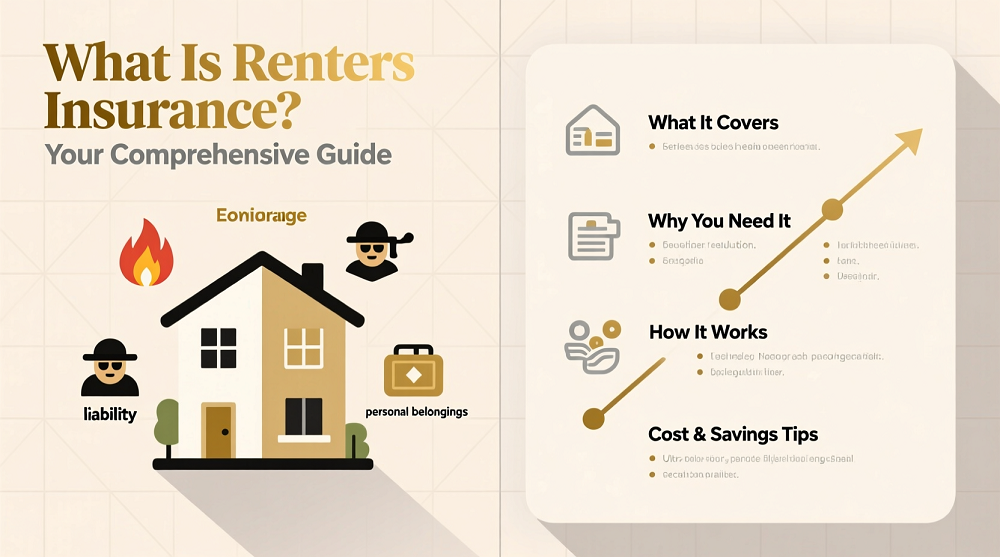

Renters insurance represents a specialized financial safeguard specifically designed for individuals who lease their living spaces. This essential protection framework shields tenants from unexpected financial losses stemming from stolen belongings, accidental property damage, liability claims, and temporary displacement. Unlike homeowners insurance, which protects the physical structure, this coverage focuses exclusively on your personal possessions and legal exposures.
Core Definition: Renters Insurance Beyond the Basic Explanation
Renters insurance is a contractual agreement between a tenant and an insurance provider where the insurer agrees to compensate the tenant for covered losses in exchange for regular premium payments. This arrangement transforms unpredictable, potentially catastrophic financial risks into manageable, predictable expenses. The policy serves as a financial buffer against life’s uncertainties within a rented environment.
The Three Pillars of Renters Insurance Protection
Modern renters policies function as a triad of interconnected safeguards, each addressing distinct vulnerability areas tenants face.
1. Renters Insurance: Personal Property Safeguard
This foundational component provides monetary reimbursement for the loss, theft, or destruction of your belongings. Coverage extends to furniture, electronics, clothing, kitchenware, and other personal items. Policies typically recognize two valuation methods:
- Actual Cash Value (ACV): Reimburses items minus depreciation based on age and wear
- Replacement Cost Value (RCV): Provides funds to purchase new equivalents of lost items
Important nuance: Most policies impose specific limits on high-value categories like jewelry, art, or collectibles, requiring separate scheduling for full coverage.
2. Renters Insurance: Personal Liability Shield
This protection activates when you are found legally responsible for causing bodily injury or property damage to others. Consider these scenarios:
- A guest trips over your rug and requires medical treatment
- Your bathtub overflows, damaging the apartment below
- Your dog accidentally bites a visitor
The policy covers legal defense costs, settlement amounts, and court-awarded judgments up to your selected limit, typically starting at $100,000 but often recommended at $300,000 or higher.
3. Renters Insurance: Additional Living Expenses (ALE) Coverage
When a covered peril renders your rental unit uninhabitable, this provision covers the incremental costs of maintaining your normal standard of living elsewhere. Covered expenses include:
- Hotel or temporary rental accommodations
- Restaurant meals exceeding your normal food budget
- Storage fees for undamaged belongings
- Pet boarding costs during displacement
ALE coverage typically represents 20-30% of your personal property limit and has specified time constraints.
Covered Perils: What Triggers Protection
Renters insurance operates on a “named perils” or “open perils” basis, determining which events activate coverage.
| Commonly Covered Events | Typically Excluded Events | Special Considerations |
|---|---|---|
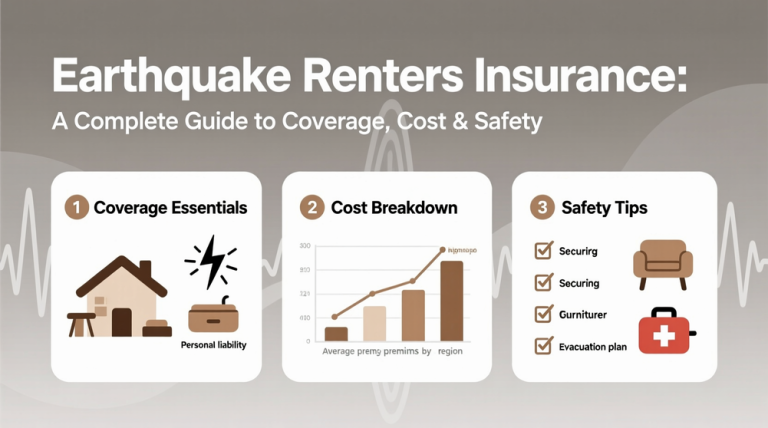
| Fire and lightning damage | Flooding (requires separate policy) | Earthquake coverage often available as endorsement |
| Theft and burglary losses | Intentional damage by tenant | Mold remediation may have strict limits |
| Windstorm and hail damage | Normal wear and tear | Sewer backup often requires added endorsement |
| Falling objects impact | Pest infestations | Identity theft coverage increasingly available |
| Accidental water discharge | Government seizure | Business property may need commercial policy |
Premium Determinants: What Shapes Your Cost
Insurance providers employ sophisticated algorithms to calculate premiums, weighing numerous risk factors:
Geographic & Location Variables
- Regional claim history: Areas with higher theft or weather claims incur higher premiums
- Proximity to fire stations: Distance from emergency services affects fire risk calculations
- Building construction: Modern buildings with safety features often qualify for discounts
- Local crime statistics: ZIP code-level crime data directly influences theft premium components
Personal & Policy Factors
- Coverage limits selected: Higher property and liability limits increase premiums proportionally
- Deductible amount: The out-of-pocket sum you choose before coverage activates (typically $500-$2,000)
- Claims history: Previous insurance claims may increase perceived risk
- Credit-based insurance scores: Used in most states to predict claim likelihood
- Safety features: Security systems, smoke detectors, and deadbolts often yield discounts
Cost Management Strategies
To optimize your premium while maintaining robust protection: bundle with auto insurance (typically 5-25% discount), increase your deductible strategically, maintain good credit where permitted, inquire about all available discounts (non-smoker, professional association, paperless billing), and annually review your coverage needs to avoid over-insuring depreciated items.
The Critical Landlord-Tenant Coverage Distinction
A fundamental misunderstanding persists regarding responsibility boundaries in rental arrangements. The property owner’s insurance policy (landlord insurance) exclusively protects the physical structure—walls, roof, built-in appliances, and common areas. This policy does not extend to tenant possessions or liability. Conversely, your renters insurance never covers damage to the building itself. This creates a complementary protection ecosystem where both parties carry appropriate, non-overlapping coverage.
Practical example: If a kitchen fire destroys both the apartment’s cabinets (landlord’s responsibility) and your personal cookware (your responsibility), each insurance policy addresses its respective domain. Without renters insurance, you would bear the full replacement cost of your belongings despite the landlord’s coverage.

Strategic Policy Selection Framework
Selecting appropriate coverage requires methodical assessment rather than guesswork. Follow this structured approach:
Step 1: Comprehensive Inventory Development
Document every possession through photographs, videos, and detailed descriptions. Note purchase dates, original costs, and serial numbers. Specialized applications can streamline this process, creating a cloud-based record inaccessible to physical damage.
Step 2: Accurate Valuation Calculation
Most tenants significantly underestimate their belongings’ total value. The average renter possesses $20,000-$30,000 worth of items. Calculate room-by-room totals, remembering to include clothing, linens, kitchen equipment, electronics, furniture, and hobby equipment.
Step 3: Liability Limit Assessment
Evaluate your net worth, future income potential, and lawsuit exposure. In litigious environments, $100,000 represents a bare minimum, with $300,000-$500,000 providing more robust protection for modest additional premium.
Step 4: Endorsement Evaluation
Identify items requiring scheduled personal property endorsements: fine art, musical instruments, camera equipment, collectibles, or high-end electronics. These additions ensure appropriate coverage beyond standard sub-limits.
Claims Navigation Protocol
Understanding the claims process before needing it ensures optimal outcomes during stressful events.
- Immediate safety and documentation: Secure the premises, prevent further damage, and document extensively with photographs and videos before disturbing anything.
- Prompt notification: Contact your insurer immediately, even if unsure about claim filing. Most policies require “prompt notice” of potential claims.
- Detailed loss documentation: Provide your pre-created inventory alongside evidence of damaged items. For theft, file a police report within 24 hours.
- Adjuster collaboration: The insurance adjuster will investigate the claim, verify coverage, and determine settlement amounts based on your policy terms.
- Temporary repairs: Make only necessary repairs to prevent further damage, keeping all receipts for reimbursement.
- Settlement review: Carefully review the settlement offer against your policy terms before accepting. Negotiate if discrepancies exist.
Specialized Considerations and Edge Cases
Roommate Coverage Dynamics
Most standard policies exclude unrelated roommates unless specifically named on the policy. Some insurers offer roommate endorsement options, while others require separate policies. Shared property presents particular challenges—document ownership percentages for major items.
Home Business Exposures
Standard policies typically exclude business-related property and liability. A client slipping in your home office or damaged business equipment may lack coverage. Endorsements or separate business policies address these gaps.
College Student Considerations
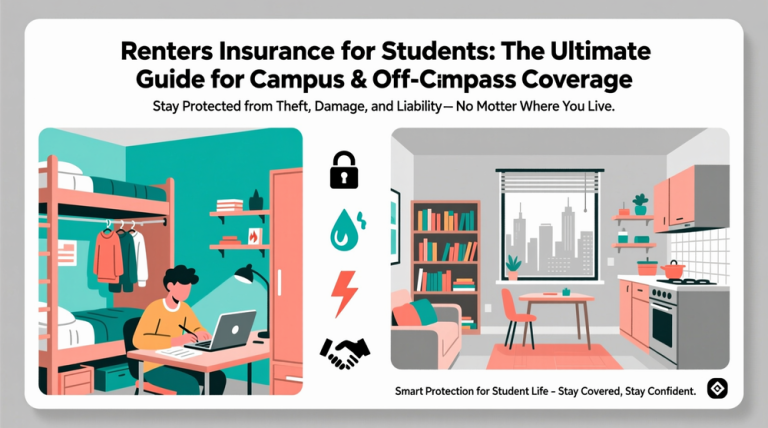
Students living in dorms may have limited coverage under parental homeowners policies. Off-campus housing generally requires separate renters insurance. Many universities now mandate proof of coverage for off-campus students.
Short-Term Rental Implications
Platforms like Airbnb create complex insurance scenarios. Some hosts’ policies may provide limited coverage, but guests generally need their own protection for belongings and liability during stays.
Periodic Coverage Reassessment Protocol
Renters insurance represents a dynamic protection tool requiring annual review. Life changes necessitating adjustment include:
- Significant purchases (electronics, furniture, jewelry)
- Relationship status changes affecting shared property
- Home office establishment or business equipment acquisition
- Regulatory changes in your state affecting coverage requirements
- Building security improvements qualifying for new discounts
- Accumulation of collectibles or valuable items
Conclusion: Renters Insurance; The Non-Negotiable Protection
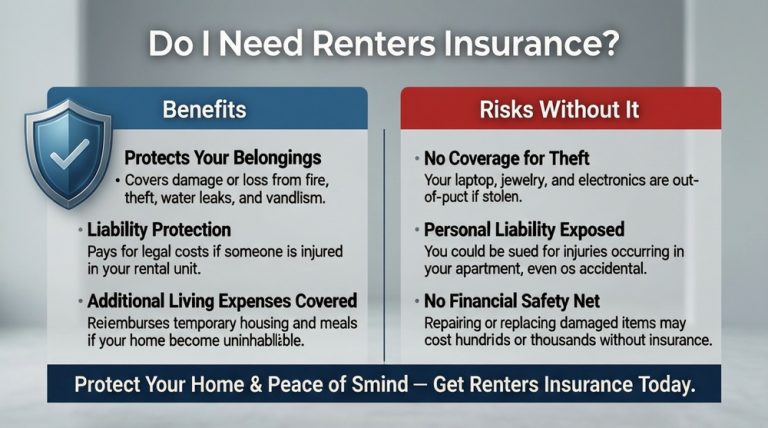
Renters insurance transcends mere optional coverage—it represents fundamental financial literacy for the modern tenant. This protection framework safeguards against three distinct vulnerability categories: property loss, legal liability, and displacement costs. With average premiums representing less than the cost of one dinner out monthly, this coverage delivers disproportionate value against potentially catastrophic financial exposures.
The most sophisticated approach involves viewing your policy not as a static purchase but as an adaptable component of your overall financial security strategy. Regular reviews, informed adjustments, and clear understanding of terms transform this contractual arrangement from bureaucratic necessity to empowering financial tool. In an era of increasing climate volatility and litigious environments, intelligent renters recognize this coverage not as an expense but as essential risk management.

[…] policy covers the physical structure of the building (roof, walls, built-in appliances). Your renters insurance covers everything inside your unit that you own, your liability, and your additional living […]
[…] The amount and quality of coverage you choose directly impact your premium. This includes: – **Personal Property Limit:** This is the maximum amount your policy will pay to replace your belongings. The higher the limit, the higher your premium. For example, increasing from $30,000 to $50,000 in coverage can raise the average annual cost from $151 to $192. – **Liability Limit:** This covers you if you are found responsible for injuring someone or damaging their property. Increasing this limit, say from $100,000 to $300,000, typically adds only a small amount to your premium. – **Replacement Cost vs. Actual Cash Value:** Opting for “replacement cost” coverage (which pays to buy a new item) costs about 11% more on average than “actual cash value” (which pays the item’s depreciated value). For a foundational understanding of these coverage types, you can refer to our guide on renters insurance. […]
[…] crucial to understand your renters insurance policy details to ensure it meets these […]
[…] Ask final questions. Then, choose the insurer that offers the best combination of adequate renters insurance coverage, a fair price, strong financial ratings, and a smooth claims process reputation. Purchase […]
[…] is the most recognizable component of renters insurance. It pays to repair or replace your personal belongings if they are damaged or destroyed by a […]
[…] a standard policy framework exists nationwide, understanding the specifics of renters insurance in California is key due to the state’s distinct environmental and urban landscapes. A robust […]
[…] premium you pay for renters insurance is a calculated risk assessment by insurance companies. For apartments and houses, the risk profile […]
[…] patience and organization, a successful claim ultimately validates the importance of carrying renters insurance. By following this guide, you ensure that when the unexpected happens, you are prepared to navigate […]
[…] them as an Additional Insured can create coverage complications and is generally incorrect for a renters insurance policy. Always clarify this distinction with your […]
[…] You must schedule such high-value items separately. This directly addresses the question: renters insurance does not cover “everything” if certain items exceed these categorical […]
[…] contrast, standard renters insurance covers internal, accidental water discharge. This includes scenarios like a burst pipe, an […]
[…] renters insurance policies list “exclusions”—perils they explicitly do not cover. Common exclusions […]
[…] your standard renters insurance policy and you will find a clear “earthquake exclusion.” This means if an earthquake […]
[…] value often surprises students and parents, frequently exceeding $5,000 to $10,000. A standard renters insurance policy provides a safety net to replace these items after theft, fire, or water […]
[…] For comprehensive protection in a litigious society, pairing umbrella insurance with a solid renters insurance policy is a powerful strategy for pet […]
[…] policy covers the building itself. This includes walls, floors, and built-in appliances. Your renters insurance only covers your personal belongings inside. For instance, a kitchen fire might ruin the cabinets […]
[…] For more on determining what you need, check our resource on what renters insurance is. […]
[…] In summary, securing renters insurance with a Pitbull requires research, preparation, and persistence. Start by contacting breed-friendly insurers like State Farm. Have your dog’s “resume” ready. Be transparent about your pet. Opt for high liability limits, and consider an umbrella policy for maximum protection. Remember, your dedication as an owner is your strongest asset. By following this guide, you can find a company that will provide the necessary coverage, allowing you to enjoy life with your loyal companion, fully protected. For more foundational information, begin with our guide on what renters insurance is. […]
[…] So, what is the average cost of renters insurance? Nationally, it’s a very affordable $15-$30 per month for solid baseline coverage. Your personal cost depends on location, coverage choices, and discounts. Remember, the goal isn’t just the cheapest policy, but the best value—adequate protection at a fair price. By understanding the factors at play, raising your deductible wisely, and shopping competitively, you can secure essential financial protection without straining your budget. Start your search today to lock in your rate and gain peace of mind. For a foundational understanding, begin with what renters insurance is. […]
[…] the company is younger and has a shorter track record than legacy carriers. Ultimately, securing renters insurance is a critical step for any tenant. We recommend getting a quote from Lemonade, comparing it with […]
[…] and its financial backing is robust. However, if your sole priority is finding the absolute lowest renters insurance premium and you are comfortable managing your policy entirely online without agent interaction, you […]
[…] stability. There is no indication that the company’s core operations or ability to pay renters insurance claims are in […]
[…] is: Does State Farm do renters insurance in California? The answer is yes. State Farm writes renters insurance policies in all 50 states and the District of Columbia, including California. The benefits of State […]
[…] If your lease includes an insurance requirement clause and you fail to get a policy or let it lapse, you are in breach of your contract. The landlord’s recourse is not criminal penalty but contractual enforcement. They can issue a formal notice to “cure” the violation, giving you a set period (often 30 days) to provide proof of insurance. If you fail to comply, the landlord may have grounds to begin eviction proceedings for violating the lease terms. They may also choose not to renew your lease when it expires. For these reasons, it is imperative to carefully read your entire lease agreement before signing to understand all your obligations, including any requirement for renters insurance. […]
[…] a day. By understanding the cost factors and shopping strategically, you can secure comprehensive renters insurance that fits both your needs and your […]
[…] Start by getting auto quotes from 3-4 major insurers, then ask for a bundled quote that includes renters insurance. Compare the *bundled total* against the cost of your best standalone auto policy plus your best […]
[…] understanding these distinctions and assessing your actual risk, you can secure the right amount of renters insurance without overpaying for unnecessary coverage or, worse, leaving yourself dangerously […]
[…] foundation of any renters insurance policy is personal property coverage. Progressive protects your belongings—furniture, […]
[…] company itself is a publicly-traded Fortune 500 company, providing a layer of financial stability. Renters insurance through these channels is designed for convenience, sometimes allowing premium payments to be added […]
[…] is the most critical factor. USAA membership, and thus access to its renters insurance, is restricted to: Active, retired, and honorably separated U.S. military officers and enlisted […]
[…] can provide personalized advice without selling your lead data indiscriminately. 3) Consult trusted renters insurance review sites that offer educational content alongside sponsored links, ensuring you are informed […]
[…] hotel bills and extra food costs. For a deeper dive into the fundamentals, you can learn more about what renters insurance is and its essential role for every […]
[…] due to a covered event. For a foundational understanding of these concepts, you can explore what renters insurance is and why each component […]
[…] a broader understanding of how these coverage components work together, you can learn more about what renters insurance is and its standard […]
[…] during the quoting process. For a foundational understanding of these elements, exploring what renters insurance is provides valuable […]
[…] possessions in discrete groups. For a comparison to standard policy structures, you can explore what renters insurance is in a traditional […]
[…] net for your major assets and risks. For a clear understanding of the renters component, explore what renters insurance is and its core […]
[…] Understanding this structure is crucial, as it differs significantly from purchasing a traditional renters insurance policy directly from an […]
[…] No, standard renters insurance does NOT cover pet damage to the carpet, flooring, walls, or any other part of your rental unit. Damage caused by your pet to the physical structure or fixtures of the property is considered neglect, wear and tear, or a maintenance issue, which are all excluded from coverage under both the personal property and liability sections of a renters policy. You are financially responsible for repairing this damage, and the cost will typically be deducted from your security deposit. However, renters insurance does cover liability if your pet injures someone or damages a visitor’s property. For the fundamentals, see our guide on what renters insurance is. […]
[…] Renters insurance rarely covers mold damage. Standard policies typically exclude or severely limit coverage for mold, fungus, and dry rot. However, there is a narrow exception: if the mold is the direct result of a “covered peril” that is sudden and accidental, such as water damage from a burst pipe or a leaking appliance, your policy may cover a limited amount for mold remediation of your affected belongings. Mold that results from long-term humidity, condensation, unresolved leaks, or poor maintenance is always excluded. Crucially, renters insurance does not cover the cost to remediate mold on the building itself—that’s the landlord’s responsibility. For foundational knowledge, see our guide on what renters insurance is. […]
[…] Yes, renters insurance absolutely covers burglary. Theft is a standard named peril in every renters insurance policy (HO-4 form). If someone breaks into your apartment and steals your belongings, your policy’s personal property coverage will pay to replace stolen items up to your coverage limit, minus your deductible. It also typically covers property damage caused during the break-in, such as a broken door, window, or lock. However, you must file a police report, and there are important sub-limits for high-value items like jewelry, electronics, and cash. Understanding these details is key to making a successful claim. For the basics, see our guide on what renters insurance is. […]
[…] Yes, renters insurance does cover temporary housing through a crucial part of your policy called Additional Living Expenses (ALE) or “Loss of Use” (Coverage D). If your rental unit becomes uninhabitable due to a covered peril like a fire, burst pipe, or severe storm damage, ALE will pay for you to maintain your normal standard of living elsewhere. This includes the cost of a hotel, short-term rental, restaurant meals (above your normal grocery spending), laundry, storage, and even pet boarding. However, it does not cover temporary housing for voluntary reasons, minor repairs, or power outages unless they result from a covered loss. For the basics, see our guide on what renters insurance is. […]
[…] Renters insurance covers temporary relocation (like hotel stays) if your current home is uninhabitable due to a covered disaster, but it does not cover permanent relocation or moving expenses for a planned move. The coverage for temporary housing is called Additional Living Expenses (ALE) or “Loss of Use.” It pays for you to live elsewhere while your rental is being repaired after events like a fire or burst pipe. However, it will not pay for security deposits, moving trucks, utility transfers, or any costs associated with voluntarily finding and moving to a new permanent apartment. For foundational knowledge, see our guide on what renters insurance is. […]
[…] dollars per month. For a foundational understanding of what you are paying for, you can explore what renters insurance is and its core […]
[…] during a claim. For a foundational explanation of these standard elements, you can explore what renters insurance is and how each part […]
[…] it is likely covered. For a foundational understanding of this protection, learn more about what renters insurance is and how it applies to your […]
[…] meals, and other costs if you’re temporarily displaced. For a foundational breakdown, explore what renters insurance is in […]
[…] When a fire strikes, the personal property component of your renters insurance fire coverage becomes your financial lifeline. This coverage applies regardless of where the fire originated—whether it started in your unit, a neighbor’s apartment, or a common area. It covers items directly damaged by flames, as well as items ruined by smoke, soot, and water used by firefighters. You will be reimbursed up to the personal property limit you selected on your policy, minus your deductible. However, standard policies have sub-limits for certain categories like jewelry, art, or electronics. If you own high-value items, you may need scheduled personal property coverage to ensure they are fully covered. Having a detailed home inventory is the single most important factor in successfully recovering the full value of your lost items. To understand the full scope of property protection, learn more about what renters insurance is. […]
[…] A standard renters insurance Los Angeles policy will not cover damage from earthquakes or wildfires. This is the most crucial gap LA tenants must address. For earthquake coverage, you must purchase a separate policy or endorsement, typically through the California Earthquake Authority (CEA) or a private insurer. This coverage includes a high deductible (usually 10-25% of your personal property limit) but is vital given the seismic activity in the region. For wildfire, the situation is different: fire damage is a covered peril in a standard policy. However, if you live in a Very High Fire Hazard Severity Zone (VHFHSZ), insurers may be reluctant to offer coverage or may charge significantly higher premiums. It’s imperative to disclose your location and secure a policy that explicitly includes fire protection. For a foundational understanding of standard protections, explore what renters insurance is. […]
[…] Understanding real-world applications clarifies the value of personal liability insurance for renters. Common covered scenarios include: Slip-and-Fall Accidents: A guest or service worker trips over a rug or wet floor in your apartment and breaks an arm, resulting in medical bills and a liability claim. Pet-Related Incidents: Your dog bites a visitor or another tenant, leading to medical expenses and potential legal action. Property Damage: You accidentally cause a kitchen fire that spreads, damaging the building structure and other tenants’ belongings. Your liability coverage addresses the claims from the landlord and neighbors. Accidental Injuries Away from Home: You accidentally hit someone with a golf ball or a frisbee at the park, causing injury. Many policies provide “worldwide” liability coverage for such non-auto-related incidents. For a complete picture of how liability fits into your overall policy, explore what renters insurance is. […]