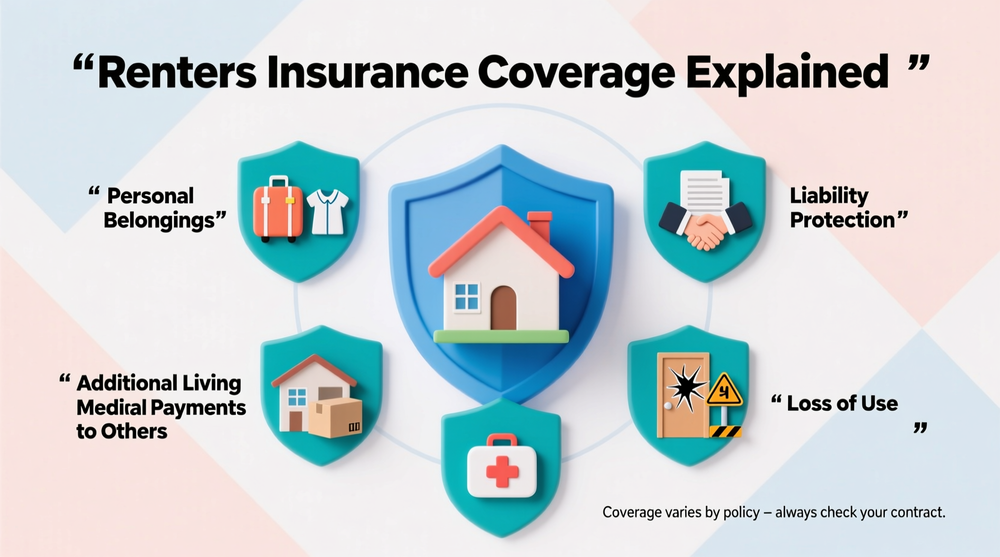

What Does Most Renters Insurance Cover? The Three Pillars of Protection
A standard renters insurance policy is built on three core coverage areas, often referred to as Coverage C, D, and E. These pillars work together to protect your finances from a wide array of common perils.
1. Coverage C: Personal Property
This covers your belongings—furniture, electronics, clothing, kitchenware, and more—against damage or loss from “named perils.” These typically include fire, smoke, theft, vandalism, windstorm, hail, lightning, explosion, and water damage from internal sources like a burst pipe or appliance overflow. It’s crucial to understand your policy’s valuation method: Actual Cash Value (ACV) pays the item’s value minus depreciation, while **Replacement Cost Value (RCV)** pays to buy a new equivalent. RCV coverage, while slightly increasing your renters insurance cost, provides far more comprehensive reimbursement.
2. Coverage D: Loss of Use (Additional Living Expenses)
If a covered peril (like a fire) makes your rental unit uninhabitable, this coverage pays for the extra costs you incur while living elsewhere. This includes hotel bills, restaurant meals above your normal food budget, laundry services, and even pet boarding. Coverage D has a limit, usually a percentage of your personal property coverage (e.g., 20-30%), and pays for a specified period until you can return home or permanently relocate.
3. Coverage E: Personal Liability
This is arguably the most critical component. It protects you if you are found legally responsible for injuring someone or damaging their property. If a guest slips in your apartment and sues you, or your child accidentally breaks a valuable item at a neighbor’s home, liability coverage pays for your legal defense, settlements, and court judgments up to your policy limit (commonly $100,000 to $300,000). It also includes no-fault medical payments (usually $1,000 to $5,000) to cover minor guest injuries without a lawsuit.
What Does Renters Insurance Not Cover? Understanding the Critical Exclusions
Knowing the exclusions is as important as knowing the inclusions. Standard policies have clear limitations and do not function as “all-risk” coverage for your rental life.
| Common Exclusion | What’s Not Covered | How to Get Coverage |
|---|---|---|
| Earthquakes & Earth Movement | Damage from earthquakes, sinkholes, or landslides. | Separate earthquake policy or endorsement (e.g., from the California Earthquake Authority). |
| Floods | Water damage from overflowing rivers, storm surges, or heavy rain entering from outside. | Separate flood insurance policy from the NFIP or private insurer. |
| High-Value Items (Sub-limits) | Jewelry, fine art, collectibles, and expensive electronics often have low limits (e.g., $1,500 for all jewelry). | “Schedule” these items by adding a rider/endorsement with an appraisal. |
| Business Property & Liability | Inventory or equipment for a home-based business; liability for business activities. | In-home business policy or business owners policy (BOP). |
| Roommate Belongings | Your policy does not cover your roommate’s possessions unless they are named on the policy. | Each roommate needs their own policy or must be a named insured. |
| Intentional Damage & Normal Wear and Tear | Damage you cause on purpose or deterioration from aging and use. | Not insurable. Responsibility falls on the tenant or landlord, respectively. |
Pest Infestations and Vehicle-Related Damage
Standard policies exclude damage from insects, rodents, or bed bugs, as these are considered a maintenance issue. Similarly, damage to vehicles (cars, motorcycles) or property inside them is not covered by renters insurance; that falls under your auto insurance policy. For a detailed look at standard industry exclusions, resources like the Insurance Information Institute’s renters insurance basics can be helpful.
What Costs Are Typically Covered by Renters Insurance?
Beyond replacing a stolen TV, renters insurance covers a spectrum of unexpected expenses that can arise from a single incident. These covered costs provide a vital financial safety net.
Direct Replacement and Repair Costs
The most direct cost covered is the value of your damaged or stolen personal property. This includes the cost to repair a smoke-damaged sofa or fully replace a stolen laptop. If you have RCV coverage, this means the full retail price of a new, comparable item. Renters insurance coverage also extends to items you own that are temporarily away from home, like a laptop stolen from your car or luggage lost while traveling (usually up to 10% of your personal property limit).
Incidental and Consequential Expenses
This is where Coverage D (Loss of Use) shines. It covers the “consequential” costs of being displaced: the daily hotel rate, the extra $40 per day for restaurant meals versus cooking at home, mileage for a longer commute to work, and laundry service costs. Furthermore, liability coverage handles the enormous costs of legal defense—attorney fees, court costs, and settlement amounts—which can easily reach tens of thousands of dollars even for a minor injury claim.
Does Renters Insurance Cover Everything in the House?
The short answer is **no, but it covers most of what you own, with important caveats.** Understanding the scope and limits is key to avoiding surprises.
It Covers Your Belongings, Not the Structure
First, a critical distinction: renters insurance covers the tenant’s possessions, not the physical dwelling. The walls, floors, built-in appliances, and plumbing are the landlord’s responsibility and are insured under their property insurance policy. Your policy covers everything you brought into the rental: your furniture, rugs, curtains, small kitchen appliances, clothing, and electronics.
Sub-Limits for Specific Categories
Even within your personal property limit, policies impose sub-limits for certain categories of items. For example, you may have $30,000 total coverage, but only $1,500 for jewelry, $2,500 for firearms, and $2,500 for business property. If you own a $5,000 engagement ring, it would not be fully covered under the standard sub-limit. You must schedule such high-value items separately. This directly addresses the question: renters insurance does not cover “everything” if certain items exceed these categorical caps.
Will Insurance Pay to Replace the Entire Floor? Tenant Liability for Property Damage
This common scenario gets to the heart of liability coverage. The answer depends on the cause of the damage and your policy details.
If the Damage is Your Fault
**Yes, your renters insurance will likely pay to replace the damaged flooring.** If an accident you cause (like leaving the bathtub running, causing an overflow that ruins the hardwood floors in your unit and the one below) damages the landlord’s property, your personal liability coverage (Coverage E) is designed for this. It would cover the cost to repair or replace the landlord’s damaged flooring, up to your liability limit. This is a primary reason landlords require tenants to carry liability insurance.
If the Damage is From a Covered Peril (Not Your Fault)
If the floor is damaged by a **covered peril** like a fire or a burst pipe within the walls (assuming you didn’t neglect maintenance), the repair cost falls to the **landlord’s property insurance**, not your policy. Your renters insurance would only cover the cost to replace your own belongings that were damaged (e.g., your area rug and furniture sitting on that floor). The distinction between tenant-caused damage and building-system failure is critical in determining whose insurance pays.
Conclusion: Mapping Your Financial Protections as a Renter
So, **what exactly does renters insurance cover?** It provides a targeted financial shield for your personal property, a robust defense against liability lawsuits, and a lifeline for living expenses if displaced. It does not cover the building itself, catastrophic natural events like floods and earthquakes, or extremely high-value items without special scheduling. By understanding the clear boundaries of the standard policy—knowing what costs are covered, what is excluded, and how liability applies to damage like floors—you can confidently secure a policy that matches your risk profile. This knowledge transforms renters insurance from a vague concept into a precise tool for safeguarding your financial well-being as a tenant.
Frequently Asked Questions (FAQs)
Does renters insurance cover a stolen bike?
Yes, if the theft occurred from your rental unit or a secured common area. If it was stolen from a public rack, it’s typically still covered under the “off-premises” theft provision of your personal property coverage, usually up to 10% of your total limit. High-value bicycles may require scheduling.
Does renters insurance cover hotel stays?
Yes, through Loss of Use (ALE) coverage. If a covered peril makes your home temporarily unlivable, your policy will reimburse you for necessary increased living expenses, including hotel or short-term rental costs, restaurant meals, and laundry.
Does renters insurance cover a broken window I caused?
Potentially, under your liability coverage. If you (or a guest) accidentally break a window in your rental unit, your liability coverage may pay for its repair as damage to the landlord’s property. Intentional damage, however, is excluded.
Does renters insurance cover water damage from an upstairs neighbor?
Your policy covers damage to *your* belongings from the water. The repair of the ceiling and walls, however, is the responsibility of your landlord (or potentially the upstairs neighbor’s liability insurance if they were negligent). Your insurer may subrogate against the at-fault party.
Does renters insurance cover mold?
Typically, only if the mold results from a *covered* water loss, like a sudden burst pipe. It does not cover mold resulting from long-term humidity, neglect, or maintenance issues (like a slow leak you didn’t report), which are considered preventable.
Does renters insurance cover moving expenses?
No, standard renters insurance does not cover voluntary moving costs. It only covers temporary living expenses if you are *forced* to relocate due to a covered loss that makes your home uninhabitable.
Does renters insurance cover appliances provided by the landlord?
No. Appliances that came with the rental (refrigerator, stove, dishwasher) are the landlord’s property and are their responsibility to insure. Your policy only covers appliances you own and brought into the unit.