
Article Summary: Filing a renters insurance claim can feel overwhelming after a theft, fire, or other covered loss. This definitive guide about how to file a renters insurance claim, walks you through the entire process, from immediate first steps to final settlement. Learn how to properly document damage, communicate effectively with adjusters, understand your policy’s fine print, and navigate common pitfalls. We detail what to expect at each stage, provide templates for inventory lists, and explain how to advocate for a fair payout. Knowing how to file a renters insurance claim correctly is the key to turning your policy from a piece of paper into real financial recovery when you need it most.
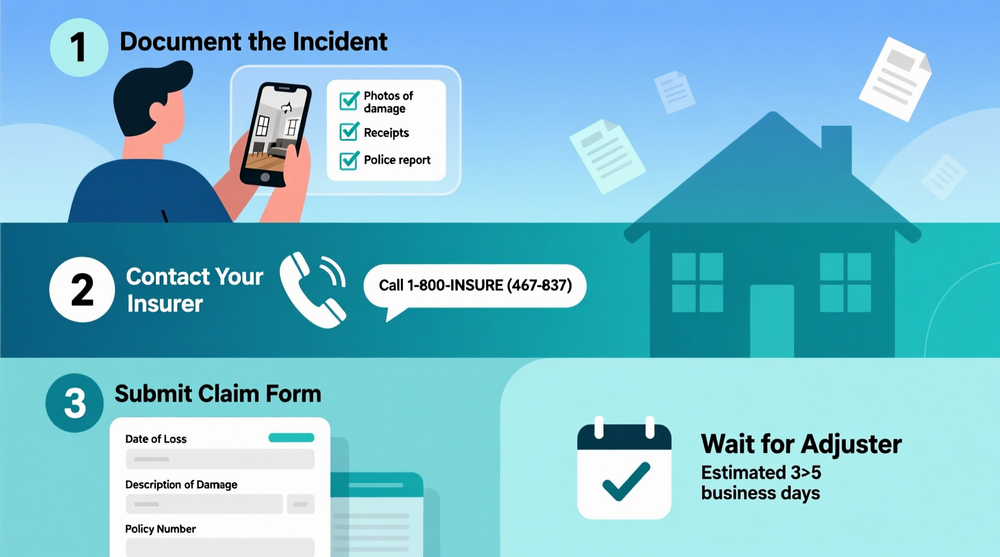
Immediate Actions: What to Do in the First 24 Hours After a Loss
Your actions immediately following an incident are critical for both safety and a successful claim. Staying calm and systematic during this stressful time protects people, prevents further damage, and creates a solid foundation for your insurance process. Follow this sequence before you even think about calling your insurer.
Step 1: Ensure Safety and Mitigate Further Damage
Your wellbeing is paramount. In case of fire or structural damage, evacuate immediately and contact emergency services (911). Once safe, take reasonable steps to prevent additional loss—this is often a requirement in your policy. This could mean turning off the water main after a burst pipe, placing a tarp over a broken window, or moving undamaged belongings to a dry area. Keep receipts for any materials purchased for these temporary repairs; these costs are typically reimbursable under your policy’s loss mitigation provision.
Step 2: Document Everything with Photos and Video
Before you touch or clean anything, document the scene thoroughly. Use your smartphone to take wide-angle photos and close-up shots of all damaged property and the area of loss. Capture serial numbers on damaged electronics if visible. Shoot a video while narrating what you’re seeing, describing items and their condition. This visual evidence is invaluable and far more convincing than a written list alone. If the incident was a crime, like theft or vandalism, file a police report immediately and obtain the report number—this official documentation is often required by your renters insurance company.
Step 3: Locate Your Policy and Review Coverage
Find your policy declarations page. This document outlines your specific coverage limits, deductible, and covered perils. Understanding your baseline—knowing your personal property limit, whether you have Actual Cash Value (ACV) or Replacement Cost Value (RCV) coverage, and what your deductible is—will frame your expectations for the entire claims process. This is the moment to clarify what your renters insurance coverage actually provides before you make the call.
How to File a Renters Insurance Claim: The Formal Process
Once initial documentation is complete, you’ll initiate the formal claim. This phase involves direct communication with your insurance carrier and sets the official process in motion. Being prepared and professional here streamlines everything that follows.
| Step | Your Action | Insurance Company’s Role | Key Tip |
|---|---|---|---|
| Initial Notification | Contact insurer via app, phone, or online portal. Provide basic info: policy #, date/loss type, brief description. | Opens a claim file, assigns a claim number and adjuster. | Have your policy number ready. Be concise but accurate in your description. |
| Detailed Statement & Documentation Submission | Submit your photos, videos, police report, and a preliminary list of damaged/missing items. | The adjuster reviews submitted evidence and may ask for additional information. | Organize digital files in a dedicated folder. Name files clearly (e.g., “LivingRoom_FireDamage_1.jpg”). |
| Adjuster Assignment & Inspection | Cooperate with the adjuster’s visit. Walk them through the damage, provide receipts, and answer questions. | The adjuster investigates the cause/scope of loss, verifies coverage, and estimates the cost to repair/replace. | Be present for the inspection. Point out all damage, even minor items you might overlook. |
| Proof of Loss Form | Complete and sign the formal “Proof of Loss” document, itemizing all claimed items and their value. | Uses this sworn statement as the formal basis for the settlement calculation. | Be meticulous. This is a legal document. Do not guess on values; use research to support figures. |
Working with the Insurance Adjuster
The adjuster is not your adversary, but they do represent the insurance company’s interests. Be cooperative, polite, and factual. Provide all requested documentation promptly. If you have receipts, manuals, or credit card statements for lost/damaged items, provide them. If you disagree with the adjuster’s assessment, you have the right to ask for clarification on how they determined value or scope. For complex claims, you can hire a public adjuster (at your own cost) to advocate on your behalf. For understanding industry standards on claims, resources from the Insurance Information Institute’s claim guide can be helpful.
The Importance of a Detailed Home Inventory
This is where pre-loss preparation pays off. A home inventory created before a disaster is your single most powerful tool when filing a claim. It eliminates memory gaps and provides proof of ownership. If you don’t have one, create it now from memory, using old photos from social media or emails as prompts. For each item, list the description, approximate purchase date, and estimated value. A detailed inventory drastically speeds up the “Proof of Loss” stage and helps maximize your settlement.
Maximizing Your Settlement and Navigating the Payout
Understanding how settlements are calculated and the options available to you is crucial to ensuring you receive the full value you’re entitled to under your policy. This phase involves negotiation, understanding depreciation, and knowing the different types of payment you may receive.
Actual Cash Value vs. Replacement Cost Value Payouts
This is the core of your settlement amount. If you have **Actual Cash Value (ACV)** coverage, you will receive the item’s current market value, minus depreciation. A 5-year-old TV will be valued much lower than its original price. If you have **Replacement Cost Value (RCV)** coverage, you will first receive the ACV amount. After you actually replace the item and submit the receipt to the insurer, they will issue a second check for the difference between the ACV and the full replacement cost. RCV coverage, while often having a slightly higher renters insurance cost, results in a significantly better payout.
Understanding Deductibles and Depreciation
Your deductible is applied once per claim, not per item. The total settlement amount is calculated, and then your deductible is subtracted. For example, if your total covered loss is valued at $5,000 and you have a $500 deductible, your net payment will be $4,500. Depreciation is the reduction in an item’s value due to age and wear. Adjusters use standardized depreciation schedules. You can challenge their depreciation estimates by providing evidence of an item’s excellent condition or by finding comparable items for sale (like on Facebook Marketplace) that show a higher current value for used goods.
Receiving Payment and Disputing a Settlement
Payment is typically issued via check or direct deposit. For large losses, it may come in multiple installments. If you have a mortgage on any items or your landlord is named as an “additional interest,” the check may be co-payed. If you believe the settlement is unfair, first discuss it calmly with your adjuster, providing additional evidence. If unresolved, you can request a formal review by a supervisor. Your final recourse is to file a complaint with your state’s Department of Insurance or seek legal counsel. Always communicate disputes in writing for a clear record.
How to File a Renters Insurance Claim: Conclusion
Knowing how to file a renters insurance claim transforms a chaotic disaster into a manageable recovery project. By acting swiftly to document the loss, communicating clearly with your adjuster, and thoroughly substantiating your losses, you take control of the situation. Remember, your policy is a contract, and you have a right to the benefits you’ve paid for. While the process requires patience and organization, a successful claim ultimately validates the importance of carrying renters insurance. By following this guide, you ensure that when the unexpected happens, you are prepared to navigate the path to reimbursement and restoration efficiently and effectively.
FAQs About How to File a Renters Insurance Claim
How long do I have to file a renters insurance claim?
You should notify your insurance company as soon as possible after a loss—most policies require “prompt” or “immediate” notification. While there’s often a formal deadline (like one year from the date of loss) written in the policy, delaying can complicate the investigation and potentially jeopardize your claim. Always report it right away.
Will filing a claim increase my renters insurance premium?
It might. Filing a claim, especially for a large or frequent loss, can lead to a premium increase at renewal time because you are now statistically a higher-risk policyholder. For small losses that are close to your deductible amount, it’s often wiser to pay out-of-pocket to avoid a potential rate hike and a claims record.
What if my claim is denied?
First, request a detailed written explanation for the denial from your insurer. Review your policy to see if the denial aligns with the exclusions. If you believe it’s in error, you can appeal by providing additional documentation. Your next steps are to file a complaint with your state’s Department of Insurance or consult with an attorney specializing in insurance law.
Does renters insurance cover temporary housing if I can’t live in my rental?
Yes, through Additional Living Expenses (ALE) or “Loss of Use” coverage. If a covered peril (like a fire) makes your home uninhabitable, your policy will reimburse you for the extra costs of temporary housing, meals, and storage, up to your policy’s limit and for a specified time period. Keep all related receipts.
What is not covered in a typical renters insurance claim?
Standard policies exclude damage from floods, earthquakes, routine wear and tear, pest infestations, and intentional loss. They also have sub-limits for high-value items like jewelry, art, or collectibles unless they are specifically scheduled (added with an appraisal). Always review your policy’s “exclusions” section.
How long does the entire claims process take?
For straightforward claims (like a stolen laptop with a police report), settlement can occur in a matter of weeks. For complex claims involving major fire or water damage, the process from inspection to final payout can take several months, depending on the investigation’s complexity and the scope of repairs/replacements needed.
Can I choose my own repair vendors or do I have to use the insurer’s?
You have the right to choose who repairs your belongings or performs cleaning/restoration. The insurer may provide a list of preferred vendors, but you are not obligated to use them. However, preferred vendors often work directly with the insurer on pricing and guarantees, which can simplify the process for you.